Space Elevators
A space elevator (or "orbital elevator") is a theoretical structure that provides a direct transportation route from Earth's surface to space.
Space elevators can (or should be) equipped with an electric vehicle that drives up and down a tether between the ground and a satellite in orbit. This form of transportation will be a more cost efficient and environmentally-friendly alternative to rockets.
Key Components
| Component | Description |
|---|---|
| Anchor | The base of the elevator works as an anchor to a location on Earth's equator (because the planet's rotational speed is greatest at the equator -> good for stabilization). |
| Tether | A long, cable or tether that extends from the Earth's surface into space. The material for the tether needs to be incredibly strong, e.g., made of carbon nanotubes or graphene. |
| Counterweight | At the opposite end of the tether, there needs to be a counterweight located beyond the geostationary orbit (35,786 km). This counterweight keeps the tether taut due to the centrifugal force generated by Earth's rotation. |
| Climber / Elevator Car | A robotic climber or elevator car that travels along the tether, between Earth and space to carry cargo, spacecraft, or passengers. |
How it Works:
The tether is kept under tension by the balance between gravitational forces pulling the structure toward Earth and the centrifugal force from Earth's rotation pulling the counterweight outward. If this balance is maintained, the tether remains stable and straight. The tether and the counterweight must cross the geostationary orbit (around 35,786 km altitude), because objects at this height orbit Earth at the same rotational speed as the planet. Thus, they appear to hover over a single point on the equator. The counterweight ensures that the necessary tension to stabilize the tether is maintained. Elevator climbers then ascend and descend along the tether using electric motors or other propulsion methods, e.g., powered by solar power.
The energy requirements would be much lower than rocket launches, making space access cheaper and safer.
European Space Elevator Challenge
The Technical University of Munich regularly organizes the European Space Elevator Challenge (EUSPEC) to share experience and spread awareness and understanding of the Space Elevator system. Participants design and build a climber structure in compliance with predetermined requirements.
For more information, see https://warr.de/projekte/euspec/.
Japan's Race to the Top
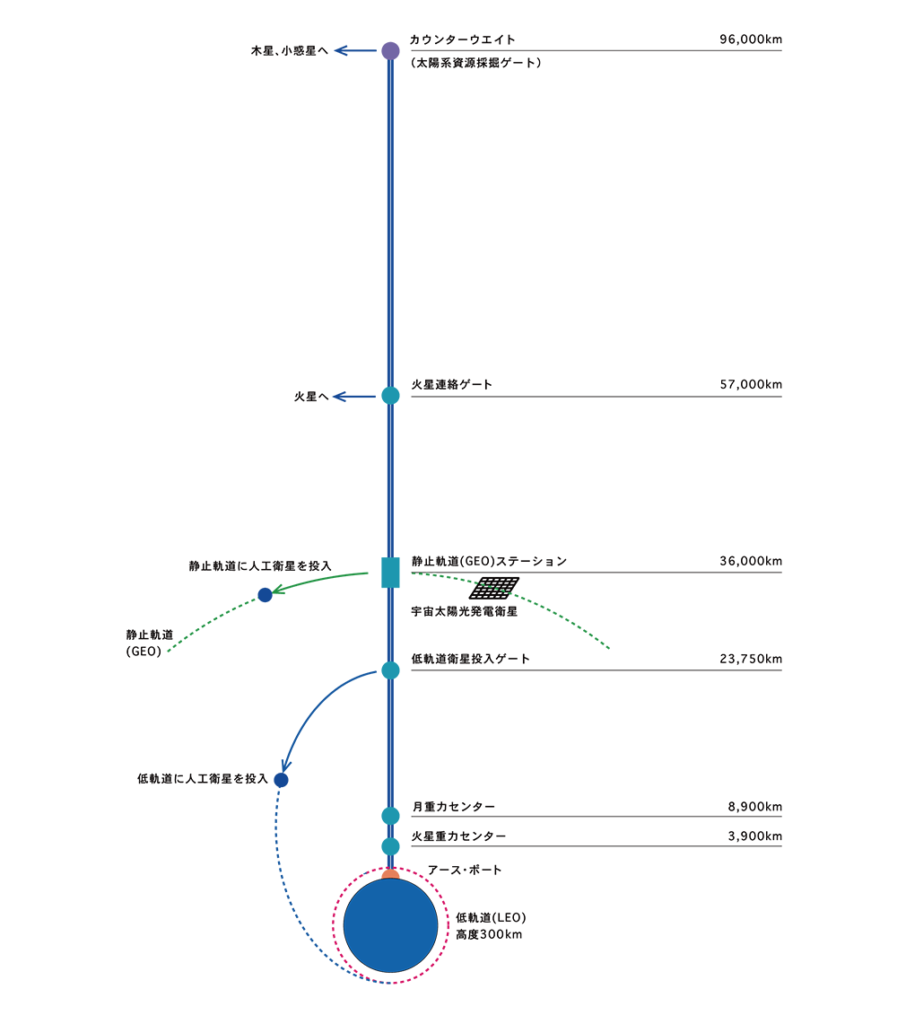
The Obayashi Corporation, one of Japan’s top construction companies, plans to start construction of a space elevator in 2025, and use the space lift in 2050.
Velocity
At a launch speed of 150 km/h, the Climber will reach an altitude of 400 km (where the International Space Station is located) in about 2.5 hours.
Energy Supply
The project includes deploying a Space Solar Power System (SSPS) satellite at an altitude of 36,000 km. Unlike solar power on the Earth’s surface, SSPS is not affected by the weather.
The energy received by the 2 km² of solar panels floating in space is then sent as “microwaves” to the receiving antenna on Earth. The receiving antenna is called a “rectifying antenna” and has a diameter of 2.5 km over the sea.
The Space Solar Power System will be able to transmit energy wirelessly over a distance of 36,000 km